I have visited many blogs since I started Technically Easy, and have come across blogs of different genres. I have read travel, technical, photography and money-making blogs. The one type of blog that I do enjoy reading are the personal blogs, where individuals just talk about their life.
This week I look at a personal blog. The one thing about these types of blogs is that it allows the author to pretty much talk about anything they are interested in for that particular day.
When viewing blogs I like original blogs. It seems most blogs today discuss the saturated topic of making money online, or SEO (Search Engine Optimization). When I see a blog that is not focused on one of those two topics, it is like a breath of fresh air.
This week I look at a sports related blog, specifically F1 racing. I am not a F1 racing fan, but this is definitely one of the best blogs I have seen. Lots of content, a specific topic, with a great design.
Web Site: F1-ToGo
Description: Dedicated to the fast paced world of F1 racing. Featured are original content news stories, opinions, and a bit of controversy along the way.
Design
The design of F1-ToGo is well done. It is a standard design with the content on the left and two navigation sidebars on the right. There is also a menu bar at the top of the blog for easy access to important pages.
First let’s have a look at the content section. The titles are nice and large and easy to read. The font and font size chosen for the content is also nice and large. Anyone should have no trouble reading the posts.
The sidebars on the right are neatly organized, which is unusual considering the amount of information the author has provided. There are ads at the top, however, they don’t drown out the actual navigation links. There are a few ads on the right side of the sidebar, while the navigational links are on the left.
There are many categories in the sidebars with each one having a well-defined header. The categories, recent posts, and favourite posts are near the top of the left side of the sidebars. This allows visitors to find the posts without having to scroll down the page.
The only issue I found with the design was with IE7. When I viewed the sidebars in IE7 the “Recent Viewers” widget from BlogCatalog stretch from the left side to the right side.
The overall design of the blog is well done, and shows how a great blog should look.
Focus
The focus of F1-ToGo is simply F1. Every post is related to F1 racing, and includes discussions on tracks, results, drivers, teams, and rumours. The focus is clear and well-defined. No problems with the focus on this blog.
Content
The design and and the focus are top-notch, and the content is also in that category. After reading some of the posts, I am amazed at how well each post is written.
Most of the posts discuss drivers, teams and upcoming races. For race results, the author includes the placing of all drivers as well as the fastest laps. The content of F1-ToGo shows the author’s passion for the sport without a question.
Spelling and Grammar
I found that the posts are well written and contain very few spelling and grammar mistakes. For those posts that do have a mistake, the mistake doesn’t reduce the readability, or distract from the point the author is trying to make.
Overall
This is one of the best designed and written blogs that I have reviewed. I’m not a fan of F1 but I still read many of the posts on F1-ToGo mainly because they are very well-written. The sidebars are well organized, and the fonts and sizes chosen make the blog very easy to read.
If you are a fan of F1, then you should definitely check out this blog. If you aren’t you should still check out this blog and see what a great blog looks like.
There are many blogs for various niches online. Some blogs are focused specifically on a single niche, while others may focus on several niches. Those that do focus on several niches will hopefully focus on niches that complement each other, such as discussing PC games and video cards.
This week’s blog is really difficult to determine the niche. The author has chosen to discuss a variety of topics, which unfortunately doesn’t provide a nice flow for the visitors.
I have reviewed a few money making blogs in the past, and I can honestly say that I am not a fan of that niche. It seems there are more blogs in that niche than in any other niche, and they all contain the same information.
Needless to say, as I read the title for this blog I immediately thought about the money making blogs. When I read the blog I realized there was much more to this blog than just making money, in fact this blog is missing some of the elements that are commonly found in the “make money online” blogs.
Web Site: Internet Business Guide For First Class Progress
Description: This Internet Business Guide For First Class Progress provides you with step-by-step tutorials, marketing strategies, and techniques to shorten your learning curve and boost your online success so you, too, make money online.
Design
The blog has a simple design to it – the content on the left and the navigational links on the right. This keeps the blog clean and makes reading the posts and finding links easy. The background of the blog contains an image, however, the image is simple and doesn’t distract from the content in any way. The background is a nice light colour, and with the dark font provides a nice contrast for easy reading.
The header is nice and simple with the title of the blog, an easy to locate search bar, and two clearly labelled links. The subscription information is located in the top-left, which is one of the first things you will notice.
The content section contains nice large fonts for the title and includes a line separating the posts. The font face and size chosen makes reading the blog very easy for those that have trouble reading smaller text.
The right navigation sidebar that contains the links is well done and very nicely grouped. The links included in the sidebar are minimal but contain the important links such as categories and archives. The only advertising I noticed is under the “Products” section in the sidebar. The lack of advertising is what separates this blog from the ordinary “make money online” blogs, and that makes this blog better.
Secondary, not important, links are located out of the way in the footer. If you choose to use these links the author has provided them below the main content.
Overall I like the simplicity and spacious layout of Internet Business Guide for First Class Progress.
Focus
The focus is mainly on helping you increase your online presence for those looking to make money online. As I said before this is much different that those “make money online” blogs. The posts in the blog definitely fit the niche very well, and clearly stay on focus.
A few posts here and there may stray from the focus, but those posts are rare and still provided great information for anyone looking to better their online success.
Content
The content is one of the best parts about the blog. The content is really well written and the author makes it very easy to understand what he is trying to say.
Many of the posts also include an image that is appropriate for the topic of the post. Although many of the images appear on the home page, the author has taken the time to resize the images so they are small in both size and bytes. This will allow those with slower connections load the pages quickly.
On Sundays the author has included inspirational videos. These videos provide you with even more information about succeeding online. The author, however, hasn’t posted the latest video as of this post.
I enjoyed the content provided on this blog and read many of the posts offered.
Spelling and Grammar
It is rare to find blogs that have almost perfect spelling and grammar, but this blog comes close, very close. It is apparent that the author takes the time to read and check for spelling and grammar errors in each post. This makes the blog much easier to read as you don’t need to reread a sentence twice.
Overall
This is a great blog for those that are looking to help succeed online. The posts are well written and provide great information for success. The simplicity of the layout, and the colour chosen definitely are a nice change from those blogs that include many pictures and small fonts.
If you are just starting out online, or have been online for many years, you definitely want to check out Internet Business Guide for First Class Progress.
Your site is built and you’re ready to invite people from anywhere and everywhere to check out your content. Assuming you’ve built a solid foundation on the basics – relevant original content and easy navigation – here are valuable SEO strategies to maximize your content marketing efforts.
Low Cost Hosting
One way to cut hosting costs of a website is to use a platform such as iPage. Not only does it only cost a few dollars per month, it provides user-friendly tools, making it easy for anyone to create websites. This solution can be used by website owners or an outsourced online marketing team to cut costs. At the same time, iPage provides useful tools for creating very professional websites.
Easy Access Business Information
When people come to your site they should be able to figure out immediately where they can find answers to their questions about your business, especially contact information. If you don’t include a contact page, at least give some type of contact information such as an email address or social media profile on your about page.
The easiest way to ensure visitors have no way to get confused or lost about your business location or who to contact, is to include contact information or a link to it at the top of your home page. Links to social media profiles are extremely powerful CTAs to encourage interaction with your brand.
Another reason why you need easy-to-find CTAs relates to your mobile audience that uses smartphones to make purchasing decisions while shopping. You can increase conversions if you provide easy access to coupons or coupon codes. Many local brick and mortar businesses still promote their phone numbers and physical addresses at the top of every page to remind followers that their businesses are more than just websites.
Fresh Brand-Building Content
Whether your site comprises articles, blogs, videos or other formats, you must constantly update your content to stay relevant. Websites that only consist of less than ten pages and never evolve, tend to never develop a significant following, even if those ten pages are incredibly awesome. People have more reason to return to your site if it keeps growing in content. This article provides important tips for building and managing SEO-driven web content.
A key SEO advantage to creating as many web pages as possible through an expanding blog series is that it gives you increasing opportunities to get indexed by search engines. Google is more likely to take your site seriously as a hub for authoritative thought leadership if you keep adding valuable original content about your brand. Over half of websites worldwide use a Content Management System (CMS) to make content creation more efficient, according to W3Techs.
Brand awareness is essential to business success, since consumers witness hundreds to thousands of brands per day. They have so many choices thrown at them during any given online session, that you need to take measures to ensure web visibility. The more informative web pages you add to your site, the better chances you have of attracting people in your target market. Here are SEO factors in which Google weighs strongly in its search rankings:
High-quality content.
Relevant link building.
Elaborate content of at least 1,000 words.
Use of at least a single image.
Part of what drives traffic is SEO, but it’s worth repeating that another crucial component is updating your content. According to HubSpot, sites that publish over 16 blogs per month get three times more traffic than sites with less than five new posts per month. Another interesting statistic is that updating old text and images can increase organic traffic by over 100%.
Customer Reviews
The reason it’s important to allow audience interaction through a social media company is because customer reviews are now a huge influence on final purchasing decisions made by consumers. The public now puts more faith in reviews than from media advertising. If you find that negative feedback overshadows positive feedback on your social media profile, take that as a marketing research hint.
Something you must realize before trying to craft a scheme to flood the internet with positive reviews is that most consumers have become skeptical of overly positive reviews. If every review is a glowing endorsement packed with marketing jargon, guess what happens? People think the reviews are fake. They even have tools to investigate review authenticity.
If automated software determines that too many positive reviews trace back to the same email account, it could be a red flag to many objective observers. Search engines might penalize and downgrade those reviewers as web spammers. Allowing a certain amount of negative reviews can give a more authentic presentation. Negatives can become positives by learning from consumer feedback what improvements need to be made.
You can expand your site’s universe of online reviews by encouraging customers to post reviews on third part local directories such as Yelp. You can also increase exposure of consumer feedback by including video testimonials on your web pages. Videos can be the best vehicles to share product information, particularly with product demonstrations and honest customer testimonials of how brand experiences met or exceeded expectations and improved people’s lives.
Focus on Direct Call-To-Action
Your site needs an obvious call-to-action at the top of every page to encourage visitors to check out your content. CTAs come in many forms, usually as short text phrases or buttons with short messages, symbols or images. They hold monumental importance in directing attention toward a specific action, such as making a purchase, filling out a form or clicking to learn more.
The most important aspect of CTAs to remember, besides making them obvious, is that they are easy-to-read and have a clear purpose. Some website owners prefer buttons that say “buy now,” while others want to present less of a sales push, so they add extra layers to the sales funnel for information seekers.
The sales funnel represents the path you pave with breadcrumbs to lead your prospects to whatever golden treasure you’ve crafted for them. Web pages full of informative nuggets are the breadcrumbs while your golden treasure is whatever purchasing opportunities you present for your target followers. CTAs are like the billboards and freeway signs that invite people to the places and stories you offer to make their journey more interesting. Ideally, this journey will lead to establishing long-term relationships with customers.
Conclusion
Websites come and go, but if you want yours to last for years and grow through time, it’s wise to implement a set of basic and creative strategies. Don’t be afraid to allow interactivity with your audience and be bold enough to give clear call-to-action statements that direct followers to your landing pages. You have the best chances of gaining high search engine visibility by embedding SEO strategies into your content presentation.
At the end of 2011, Amazon had released the Amazon Kindle Fire, a revolutionary gadget that offered Android tablet capabilities with a very affordable price. This is probably the most popular Android tablet right now, and it is predicted that this will be still popular in 2012. Now, there are lots of people bought this gadget – there are 13,174 user reviews in Kindle Fire alone.
In this article, I will try to summarize those reviews in one article, and I hope it will help the folks who are interested in buying the Amazon Kindle Fire to decide whether this gadget is suitable for them or not.
More and more businesses and startups become interested in React Native app development, and online publishers aren’t an exception. Why? The answer is below. It’s booming now!
Since 2015, when it was created by the Facebook Team, the popularity of apps built with React Native has been rapidly growing. But what is it?
React Native is an open-source JavaScript-based framework that lets developers build native iOS and Android applications that share the same codebase. To put it simply, it makes possible to write the code that will work on both iOS and Android devices, however, some platform-specific adoptions are required, too.
Moreover, respondents of the Stackoverflow Research (2018) named React Native as the third most commonly used technology.
The chances are high that you’ve already used a React Native application. Do you have Facebook, Skype or Instagram? All of them are built with React Native!
Moreover, such publishers as Vogue or Bloomberg have also chosen this technology to deliver their mobile products. Why and how can it be useful to your own news app? That’s what we’re about to find out!
Reason #1: Cross-platform compatibility: Kill two birds with one stone
One of the best things about the React Native mobile app development is that it allows creating 1 codebase to cover both platforms – iOS and Android. According to Stormotion, developers are able to reuse up to 70-80% of the code, where the other 20-30% are minor platform-specific improvements that may relate to UI components, deep linking or push notifications.
Eventually, it provides you with many other benefits:
It takes less time to deliver a working application for both platforms.
You will have to spend fewer resources to develop, test and support the apps at the post-release stage. According to Dariusz Kociecki, it may lead to a 30% decrease in costs.
Even if for some reason you decide to start with one platform, it will still take less time to create it comparing to the native development.
Moreover, it’s a great alternative to web applications that could also be opened on both iOS and Android devices but have an extremely poor performance.
Why is it good for online publishers?
Cross-platform development is especially important to online publishers whose main goal is to satisfy the widest possible audience. Since these 2 platforms cover up to 98% of the world’s mobile users (Android’s share is about 68% while iOS owes 30-31% of the market), it’s really crucial to ensure that your application will be available on both mobile operating systems.
Also, like every other company, I bet you’re looking for a cost-effective and fast solution. While native development is usually effective but not cheap and fast and hybrid development is fast and cheap but not effective, React Native takes the best from each approach and leaves out their disadvantages.
Reason #2: Top-notch UX for both iOS and Android users
With the shared codebase it’s possible to secure the same (high!) level of the user experience for your audience. By the way, it may be a tricky task during the native app development.
Due to the platform differences, it’s a typical case when native iOS and Android versions of the same application may perform differently. For example, one of the most common cases is different loading speed: while the first application loads in 1 second, the second one may require 4 seconds. It may not sound like a big deal but when it comes to the UX even the slightest difference plays a great role.
However, you may forget about such concerns when developing your mobile application with React Native. Due to the shared codebase, cross-platform React Native apps are able to reach the same high level of the UX, making sure that the audience won’t leave your app because of the poor performance.
Why is it good for online publishers?
A great UX is important to any kind of mobile apps, but online newspaper and media applications must be extremely good at it. Here are a few reasons why:
People use news app more frequently than many other kinds of applications. What do they usually do when they have a free minute? Browse social networks or check the news!
The more time loading takes, the fewer users will wait. Since people can get news from many different sources, the competition is too high to make them wait for even additional 2-3 seconds.
So when it comes to the React Native app development, you may be sure that users of both platforms will be highly satisfied with your application and won’t switch to your competitors due to poor performance.
Reason #3: Over-the-air updates
Everyone who has ever developed a native app, knows well that every new update should go through a complicated and sometimes long review process and then must be installed as a new version of the application. That may be ok if you aren’t in a hurry but the most updates don’t make global changes to the application – they just fix bugs and introduce minor improvements. And that’s when React Native helps, again!
The trick is that your application should be checked by Apple’s or Google’s review team only if you have amended the native code. Yet, the changes can be instantaneously applied if you modify the JavaScript code which is the backbone of the React native apps.
Such changes don’t require additional review and installation. Actually, they immediately spread among all your users without bothering them.
Why is it good for online publishers?
There are many cases in which over-the-air updates can play a great role. Some of the unforeseen issues (for example, law changes as it was with the introduction of the GDPR) may significantly worsen the UX, make some features unavailable or even endanger your whole business (remember the GDPR data breach penalties and fines).
Moreover, news apps are actively used by a pretty big audience. Thus, any bug can potentially affect many users at once.
Over-the-air updates, however, allow you rapidly fixing bugs and issues, leaving both review and download processes aside. Such changes will be immediately applied to existing versions of applications so users won’t even notice that something has changed.
Reason #4: It’s constantly improving
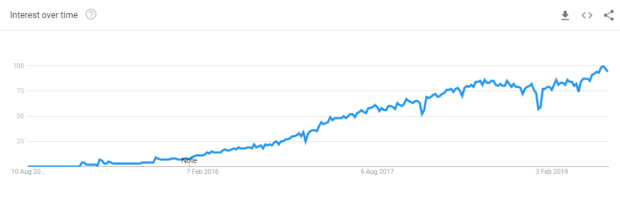
React Native is a relatively young technology, so when it first appeared there was a risk that it wouldn’t make its way to the toolbox of mobile developers. However, during this time we could notice a stable increase in interest towards this framework from both the developers’ community and clients who want their apps to be built with React Native.
We’ve already learned that React Native is an open-source framework. It means that any developer can contribute his own ideas and knowledge to improve this technology. Such a cooperative approach ensures constant development of this framework.
Just to mention: React Native is the 14th most starred repository on GitHub with over 15,500+ commits and 73,000+ stars (as of January 2019).
Why is it good for online publishers?
As an online publisher, you will be able to implement the latest features and solutions to keep the application fresh and interesting to your audience.
Also, you may not worry about possible bugs. Probably, someone has already come up with a solution and shared it for common use.
Reason #5: Lots of JS developers to choose from
As you remember, React Native is based on the JavaScript programming language. It’s the main language for web development so the ones involved in it shouldn’t face too many difficulties when learning React Native. Also, JavaScript is more widespread than native mobile programming languages (Swift or Kotlin if we’re talking about the most modern ones).
As a result, the market of JavaScript developers far more broader than the same for native mobile developers. Eventually, it means that you can easily find an appropriate tech partner to deliver your mobile product.
As Stackoverflow puts it in their 2018 Report, JavaScript has taken the position of the most commonly used programming language for the sixth year in a row.
Why is it good for online publishers?
Newspaper and media applications are the kinds of projects that usually don’t require creating your own in-house team. The optimal solution in this case is to find a remote React Native partner and outsource the development.
Since the market of JS developers is quite wide, you will have many options to choose from and will be able to find the team that is on the same page with you and doesn’t go out of your budget.
Takeaways
As you can see, despite React Native is relatively young technology, it is actively used by many startups and businesses, including online publishers and media.
Why?
Because it has a bunch of great advantages that allow us to consider React Native as the best alternative to the native or hybrid mobile development so far. Let’s briefly recall how it can be useful to your online media app:
You can create a single codebase that can be used to deliver apps on both platforms (iOS and Android). In other words, it’s possible to create 2 independent applications using the same code and small platform-specific improvements.
This technology ensures the same high level of the UX and performance across all platforms.
Over-the-air updates allow fixing bugs and implementing improvements immediately and bypassing the App Store or Google Play review processes.
Since React Native is the open-source framework, it’s actively developing thanks to the community contributions.
The market of JavaScript developers (React Native uses JS as the programming language) is pretty wide so you won’t face troubles when trying to find your perfect partner.
There is much debate about using the traffic ranking data from Alexa. Some sites, such as the paid review sites, use it to determine the amount of traffic your site receives. Many individual webmasters don’t care much for the data as it doesn’t present an accurate picture of traffic.
I don’t put too much stock into the actual ranking on Alexa, as it may not provide a complete traffic picture. I do, however, know that many sites and individuals use it as sort of a gauge as to the amount of traffic your site gets. In this post I’ll explain what Alexa is, and provide a simple, yet controversial method of increasing your traffic rank.