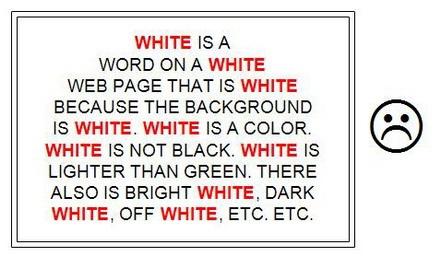
One thing I see on the Internet quite a bit these days in the age of search engine optimization is keyword stuffing. Nothing ruins content and makes reading anything a bore more than a blog post or article full of repetitive keyword usage. Because people assume more keyword usage will attract better Google listings, this epidemic has risen to biblical proportions and it’s making the Internet hard to digest.
If you’re writing a blog post for one of your client’s sites, make sure it’s at least half-way acceptable as a piece of work that might interest at least one person who actually wants to read on the subject. The line between true content and pure scheming is quite blurred. Take the noble path and don’t contribute to the bad side.
The Internet is like the ocean and throwing articles out there that read like robotically produced advertisements isn’t appealing to anybody. Any SEO guy’s main goal should be to write content worth a read. This is the natural way to acquire backlinks ensuring the Internet isn’t full of complete junk and you still get your website its hits.
Similar to the “green” environmental movement, adopt a “green” state of mind with the Internet and consider what you’re throwing into it. Google is already starting to crack down on it but their algorithms will be a lot more efficient sooner or later and they’ll be able to keep most of that crap from working at all.
Not to mention, as an aside, raising the bar for SEO content can only make the SEO field a more viable area for work. To get worthy blog content out there takes more manpower and work hours. More jobs have never been a bad thing for the economy.
To illustrate the correct behavior and methods to writing blog content, consider the following scenario. Let’s say your website is Beck Studios.
They specialize in all stage equipment including theater rigging, stage curtains, and theatrical lighting. If I were to write content for this site, the first paragraph of the article shouldn’t read “If you’re in the market for stage lighting, consider your options.
There is a difference between theatrical lighting and theater lighting. Theatrical lighting is more professional. Also, don’t forget about stage curtains. Stage curtains can make your theater experience better and if you need stage rigging check out Beck Studios because Beck Studios also offers theatrical lighting and don’t forget they have stage curtains as well so if you’re looking for good theater stuff, check out a place like Beck Studios because they have the best stage lighting (including 4-bulb stage lighting, 16-bulb stage lighting, and the best 24-bulb stage lighting.
They also offer velour stage curtains, plastic stage curtains, as well as my favorite, paper stage curtains.” That wasn’t fun for anyone to read. I know it’s not possible to get keyword-rich content out there all the time but don’t lower your standards this much. Have trust that if your content is good enough, it will get the attention it deserves and your site will get its customers eventually.
In these ways, we can keep the Internet from being an ocean full of garbage lacking any usefulness or benefit to consumers. Your blog content and backlink methods don’t have to result in Shakespearean quality of literature, but make an effort. You should be able to answer “yes” when asking yourself, “Is this blog content or article at least somewhat useful and worth any human’s time?”
If all Internet users comply with this simple rule, we can make sure link-stuffing and keyword manipulation is kept at bay so true consumers can use the Internet as a beneficial tool.
Image credit: rafizeldi.


13 Comments
Hi Alex, Nice information appearing here. Yes the keyword stuffing is main in for every site of on-page optimization. I think it should be between 4% – 5%. But the think is there is no perfect keyword stuffing. Thanks to share this informative post.
Hi Alex, thanks for this informative post. I’ve been doing this before and paid the prize when the Penguin update was released. Now I’ve learned. It’s advisable to only have 1-5% keyword density.
One way to ensure that you’re not overdoing it with your keywords is to use several on each page that are unique to that page. These keywords should come from the keyword groups that you have learned.
Thanks for this Alex. Keyword stuffing is one of the elements that our company is already handling with care. We see to it that the keywords are not stuffed into the site, but rather are scattered in necessary pages. But this, we are not only following the Penguin’s algorithm, but is also benefiting by not being penalized by Google. We should always see to it that fresh content is generated from the pages of our site and not repetitive words boggling people’s minds.
If a search engine comes across a site that has been keyword stuffed, it is more than likely the site will be penalised. Google in particular is sensitive to overuse of keywords on a page and triggers a filter should it come across any such pages. Penalties include a website been downgraded in the search results or loss of Google PageRank.
The recent Google update has totally done away with black SEO techniques like link spamming and keyword stuffing. In my opinion these updates are making SEO a more and more professional process rather than a set of short-cuts and black hat techniques.
Hi Alex
It is good that Google now are able to detect Keyword stuffing and punish those how use it all the time. It is not nice reading at all when you search for a solution online. I guess that smart SEO people always will be on step ahead, but as long as Google are right behind them it is good I think.
Twitter: techwork_dk
Key Word stuffing is a bad idea because it can not give good digestion to everyone specially internet as you said also.it should be done by level of keyword density like this that if you have density 100% then you should this at the level of 2or 3%.
Hi Alex,
I am fully satisfied with what you have explained here.Using Lots of keywords is a bad idea.the keywords used should be in limit Of atleast 1-2 % in density that’s all.
I agree. I had to see posts that are loaded with keywords. I use Yoast and it helps to keep me on the right track. It will let you know if you’ve crossed the line with keyword density.
Twitter: Android_travels
Hi,
Keyword stuffing is very bad to do especially after the last Google updates, the best thing to do now is to write the article as natural as possible and not to do keyword stuffing.
If you wan’t to have success with Google you defensibly have to pay attention to the keyword density.
Hi Alex,
Yes – I do agree. Keyword stuffing doesn’t add any value to a website what so ever – not if the keywords is not targeted within your onpage and offpage SEO tactics. Especially with Google’s algorithms being updated on a regular base – this is one of the “older” methods that used to work when trying to deceive the Search Engines – but no longer works and as I’ve said – ads absolutely no positive value to the website and or page.
Twitter: antonrsa
As usual, an excellent article, Alex G.
Google’s Panda Algo which mainly monitors and penalizes repetitive / not unique content and Penguin Algo which in the main penalizes unnatural linking behavior, should hopefully clean up the loads and loads of junk on the internet.
I commend your advice – write good, valuable articles and avoid keyword stuffing. The objective is always ” Will a visitor value this information?” If you can’t answer that question, don’t write it, whether it’s a web page or a blog post.
Twitter: MealsInAFlash